
ContX IQ: Complete CRUD Workflow with _Application as Subject
This comprehensive example demonstrates a full CRUD workflow:
Phase 1 - Initial Read:
- Application reads a Car node selected by $carId (policy cypher MATCH (car:Car), no relationship required)
Phase 2 - Create Relationship:
- Application creates a USES relationship (property status = active) to a specific Car
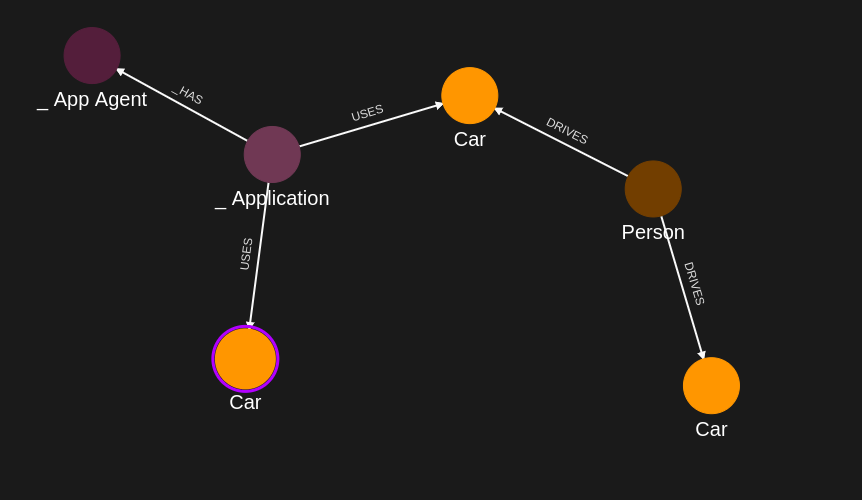
- Graph: _Application -[USES]-> Car(cadillacv16)
Phase 3 - Read with Relationship Filter:
- New policy restricts reads to Cars the Application USES (cypher MATCH (subject:_Application)-[:USES]->(car:Car))
- cadillacv16 is still returned; a car without a USES relationship would not be
Phase 4 - Create New Node:
- Application creates a new Car node and the USES relationship to it
- Graph: _Application -[USES]-> Car(cadillacv16), _Application -[USES]-> Car(LightningMcqueen)
Key concept: As relationships are added, authorization scope changes dynamically.
Use case
Scenario: A fleet management application that gradually acquires access to vehicles.
Workflow demonstration:
1. Application starts with no vehicle relationships
2. Application reads a vehicle by external_id ($carId)
3. Application "claims" cadillacv16 by creating a USES relationship
4. Future reads are scoped to claimed vehicles only
5. Application can add new vehicles to its fleet
Graph evolution:
Initial: _Application (no connections to data)
After Step 6: _Application -[USES]-> Car(cadillacv16)
After Step 12: _Application -[USES]-> Car(cadillacv16), _Application -[USES]-> Car(LightningMcqueen)
This pattern is common for:
- Multi-tenant applications
- Resource provisioning systems
- Dynamic access control scenarios
Requirements
Prerequisites:
- ServiceAccount credentials: For creating policies and queries (Bearer token)
- AppAgent credentials: For data ingestion and query execution (X-IK-ClientKey)
Required API access:
- POST /capture/v1/nodes/ and /capture/v1/relationships/ (initial data)
- POST /configs/v1/authorization-policies (multiple policies for different phases)
- POST /configs/v1/knowledge-queries (read and write queries)
- POST /contx-iq/v1/execute (run queries)
Steps
Step 1: Ingest Initial Car Data
- Authentication: AppAgent credential (X-IK-ClientKey header)
- Action: POST Person nodes (alice, knightrider, satchmo, karel), Car nodes (kitt, cadillacv16), a Bus, a Ticket and a Laptop, plus their DRIVES, OWNS, HAS and FOR relationships
- Result: Graph with vehicles ready for Application to interact with
Step 2: Create Initial Read/Write Policy
- Authentication: ServiceAccount credential (Bearer token)
- Action: POST policy with subject type _Application, cypher MATCH (subject:_Application) MATCH (car:Car), filter subject.external_id = $_appId AND car.external_id = $carId, allowing:
- READ on car and car.*
- UPSERT on the existing car node and on USES relationships (_Application -> Car)
- Result: Policy ID returned
Step 3: Create Read Query
- Authentication: ServiceAccount credential (Bearer token)
- Action: POST query that reads car.external_id and car.property.model
- Input parameter: $carId (required by the policy filter)
- Result: Query ID returned
Step 4: Execute Read Query
- Authentication: AppAgent credential (X-IK-ClientKey header)
- Action: Run the query with input_params carId = cadillacv16
- Result: cadillacv16 with model V-16 returned
Step 5: Create Relationship Upsert Query
- Authentication: ServiceAccount credential (Bearer token)
- Action: POST query that upserts subject -[USES {status: "active"}]-> car and reads the car back
- Result: Query ID returned
Step 6: Execute Relationship Creation
- Authentication: AppAgent credential (X-IK-ClientKey header)
- Action: Run the query with input_params carId = cadillacv16
- Result: _Application now connected to cadillacv16
Step 7: Create Relationship-Scoped Policy
- Authentication: ServiceAccount credential (Bearer token)
- Action: POST policy whose cypher is MATCH (subject:_Application)-[:USES]->(car:Car), same filter and permissions as step 2
- This demonstrates progressive authorization based on relationships
- Result: Policy ID returned
Step 8: Create Scoped Read Query
- Authentication: ServiceAccount credential (Bearer token)
- Action: POST query that reads car.external_id and car.property.model in the context of the scoped policy
- Result: Query ID returned
Step 9: Execute Scoped Read
- Authentication: AppAgent credential (X-IK-ClientKey header)
- Action: Run the query with input_params carId = cadillacv16
- Result: cadillacv16 returned, because the USES relationship now exists; a car the Application does not USE returns an empty data array
Step 10: Create Node Creation Policy
- Authentication: ServiceAccount credential (Bearer token)
- Action: POST policy with cypher MATCH (subject:_Application), filter subject.external_id = $_appId, allowing UPSERT of Car nodes and USES relationships (_Application -> Car)
- Result: Policy ID returned
Step 11: Create Node Creation Query
- Authentication: ServiceAccount credential (Bearer token)
- Action: POST query that upserts a Car node (external_id $carExtId, properties model = $model and color = $color) and the subject -[USES {status: "active"}]-> car relationship
- Parameters: $carExtId, $model, $color
- Result: Query ID returned
Step 12: Execute Node Creation
- Authentication: AppAgent credential (X-IK-ClientKey header)
- Action: Run the query with input_params carExtId = LightningMcqueen, model = Corvette C6, color = red
- Result: Car(LightningMcqueen) created and linked to the Application; the response returns car.external_id and car.property.model
Step 1
Capture the nodes needed for this use case.
{
  "nodes": [
    {
      "external_id": "alice",
      "is_identity": true,
      "type": "Person",
      "properties": [
        {
          "type": "email",
          "value": "alice@email.com"
        },
        {
          "type": "given_name",
          "value": "Alice"
        },
        {
          "type": "last_name",
          "value": "Smith"
        }
      ]
    },
    {
      "external_id": "knightrider",
      "type": "Person",
      "is_identity": true,
      "properties": [
        {
          "type": "email",
          "value": "knightrider@demo.com"
        },
        {
          "type": "name",
          "value": "Michael Knight"
        }
      ]
    },
    {
      "external_id": "satchmo",
      "type": "Person",
      "is_identity": true,
      "properties": [
        {
          "type": "email",
          "value": "satchmo@demo.com"
        },
        {
          "type": "name",
          "value": "Louis Armstrong"
        }
      ]
    },
    {
      "external_id": "karel",
      "type": "Person",
      "is_identity": true,
      "properties": [
        {
          "type": "email",
          "value": "karel@demo.com"
        },
        {
          "type": "name",
          "value": "Karel Plihal"
        }
      ]
    },
    {
      "external_id": "kitt",
      "type": "Car",
      "is_identity": false,
      "properties": [
        {
          "type": "manufacturer",
          "value": "pontiac"
        },
        {
          "type": "model",
          "value": "Firebird"
        }
      ]
    },
    {
      "external_id": "cadillacv16",
      "type": "Car",
      "is_identity": false,
      "properties": [
        {
          "type": "manufacturer",
          "value": "Cadillac"
        },
        {
          "type": "model",
          "value": "V-16"
        }
      ]
    },
    {
      "external_id": "harmonika",
      "type": "Bus",
      "is_identity": false,
      "properties": [
        {
          "type": "manufacturer",
          "value": "Ikarus"
        },
        {
          "type": "model",
          "value": "280"
        }
      ]
    },
    {
      "external_id": "listek",
      "type": "Ticket",
      "is_identity": false
    },
    {
      "external_id": "airbook-xyz",
      "type": "Laptop",
      "is_identity": false
    }
  ]
}
Capture the relationships needed for this use case.
{
  "relationships": [
    {
      "source": {
        "external_id": "knightrider",
        "type": "Person"
      },
      "target": {
        "external_id": "kitt",
        "type": "Car"
      },
      "type": "DRIVES"
    },
    {
      "source": {
        "external_id": "satchmo",
        "type": "Person"
      },
      "target": {
        "external_id": "cadillacv16",
        "type": "Car"
      },
      "type": "DRIVES"
    },
    {
      "source": {
        "external_id": "karel",
        "type": "Person"
      },
      "target": {
        "external_id": "listek",
        "type": "Ticket"
      },
      "type": "HAS"
    },
    {
      "source": {
        "external_id": "listek",
        "type": "Ticket"
      },
      "target": {
        "external_id": "harmonika",
        "type": "Bus"
      },
      "type": "FOR"
    },
    {
      "source": {
        "external_id": "karel",
        "type": "Person"
      },
      "target": {
        "external_id": "airbook-xyz",
        "type": "Laptop"
      },
      "type": "OWNS"
    },
    {
      "source": {
        "external_id": "alice",
        "type": "Person"
      },
      "target": {
        "external_id": "airbook-xyz",
        "type": "Laptop"
      },
      "type": "OWNS"
    },
    {
      "source": {
        "external_id": "knightrider",
        "type": "Person"
      },
      "target": {
        "external_id": "kitt",
        "type": "Car"
      },
      "type": "OWNS"
    },
    {
      "source": {
        "external_id": "alice",
        "type": "Person"
      },
      "target": {
        "external_id": "cadillacv16",
        "type": "Car"
      },
      "type": "DRIVES"
    }
  ]
}
Step 2
Create a CIQ Policy which designates the nodes which are allowed to be read and the nodes which are allowed to be upserted.
The policy filters first on subject.external_id.
When the subject is _Application, the $_appId input does not need to be provided and is automatically assigned the subject.external_id value.
The policy also filters on car.external_id. The $carId input will need to be provided in the CIQ Execution.
The policy allows the Car nodes to be read, existing Car nodes to be upserted and new relationships between the subject and Car nodes to be upserted
{
  "meta": {
    "policy_version": "1.0-ciq"
  },
  "subject": {
    "type": "_Application"
  },
  "condition": {
    "cypher": "MATCH (subject:_Application) MATCH (car:Car)",
    "filter": [
      {
        "operator": "AND",
        "operands": [
          {
            "operator": "=",
            "attribute": "subject.external_id",
            "value": "$_appId",
            "advice": {
              "error_description": "subject external_id filter error"
            }
          },
          {
            "operator": "=",
            "attribute": "car.external_id",
            "value": "$carId"
          }
        ]
      }
    ]
  },
  "allowed_reads": {
    "nodes": [
      "car",
      "car.*"
    ]
  },
  "allowed_upserts": {
    "nodes": {
      "existing_nodes": [
        "car"
      ]
    },
    "relationships": {
      "relationship_types": [
        {
          "type": "USES",
          "source_node_label": "_Application",
          "target_node_label": "Car"
        }
      ]
    }
  }
}
Json to create the CIQ Policy configuration using REST.
{
  "project_id": "your_project_gid",
  "description": "description of policy",
  "display_name": "policy name",
  "name": "policy-name",
  "policy": "{\"meta\":{\"policy_version\":\"1.0-ciq\"},\"subject\":{\"type\":\"_Application\"},\"condition\":{\"cypher\":\"MATCH (subject:_Application) MATCH (car:Car)\",\"filter\":[{\"operator\":\"AND\",\"operands\":[{\"operator\":\"=\",\"attribute\":\"subject.external_id\",\"value\":\"$_appId\",\"advice\":{\"error_description\":\"subject external_id filter error\"}},{\"operator\":\"=\",\"attribute\":\"car.external_id\",\"value\":\"$carId\"}]}]},\"allowed_reads\":{\"nodes\":[\"car\",\"car.*\"]},\"allowed_upserts\":{\"nodes\":{\"existing_nodes\":[\"car\"]},\"relationships\":{\"relationship_types\":[{\"type\":\"USES\",\"source_node_label\":\"_Application\",\"target_node_label\":\"Car\"}]}}}",
  "status": "ACTIVE",
  "tags": []
}
Json to read the CIQ Policy configuration using REST.
{
  "id": "your_policy_configuration_gid"
}
Step 3
The CIQ Query designates the Car nodes to be read.
{
  "nodes": [
    "car.external_id",
    "car.property.model"
  ],
  "relationships": []
}
Json to create a CIQ Query configuration using REST.
{
  "project_id": "your_project_gid",
  "description": "description of knowledge query",
  "display_name": "knowledge query name",
  "name": "knowledge-query-name",
  "policy_id": "your_policy_gid",
  "query": "{\"nodes\":[\"car.external_id\",\"car.property.model\"],\"relationships\":[]}",
  "status": "ACTIVE"
}
Read the CIQ Query Configuration.
{
  "id": "your_knowledge_query_configuration_gid"
}
Step 4
Run a CIQ Execution to read a Car node.
{
  "id": "knowledge_query_gid",
  "input_params": {
    "carId": "cadillacv16"
  },
  "page_token": 1
}
CIQ Execution response.
{
  "data": [
    {
      "nodes": {
        "car.external_id": "cadillacv16",
        "car.property.model": "V-16"
      }
    }
  ]
}
Step 5
The CIQ Query designates the relationships USES to be upserted between the subject and a Car node.
{
  "nodes": [
    "car.external_id",
    "car.property.model"
  ],
  "relationships": [],
  "upsert_relationships": [
    {
      "name": "newRel",
      "source": "subject",
      "target": "car",
      "type": "USES",
      "properties": [
        {
          "type": "status",
          "value": "active"
        }
      ]
    }
  ]
}
Json to create a CIQ Query configuration using REST.
{
  "project_id": "your_project_gid",
  "description": "description of knowledge query",
  "display_name": "knowledge query name",
  "name": "knowledge-query-name",
  "policy_id": "your_policy_gid",
  "query": "{\"nodes\":[\"car.external_id\",\"car.property.model\"],\"relationships\":[],\"upsert_relationships\":[{\"name\":\"newRel\",\"source\":\"subject\",\"target\":\"car\",\"type\":\"USES\",\"properties\":[{\"type\":\"status\",\"value\":\"active\"}]}]}",
  "status": "ACTIVE"
}
Read the CIQ Query Configuration.
{
  "id": "your_knowledge_query_configuration_gid"
}
Step 6
Run a CIQ Execution to upsert one relationship USES between the subject and a Car node.
{
  "id": "knowledge_query_gid",
  "input_params": {
    "carId": "cadillacv16"
  },
  "page_token": 1
}
CIQ Execution response.
{
  "data": [
    {
      "nodes": {
        "car.external_id": "cadillacv16",
        "car.property.model": "V-16"
      }
    }
  ]
}
Step 7
Create a CIQ Policy which designates the nodes which are allowed to be read and the nodes which are allowed to be upserted, according to the graph created previously.
The policy filters first on subject.external_id.
When the subject is _Application, the $_appId input does not need to be provided and is automatically assigned the subject.external_id value.
The policy also filters on car.external_id. The $carId input will need to be provided in the CIQ Execution.
The policy allows the Car nodes to be read, existing Car nodes to be upserted and new relationships between the subject and Car nodes to be upserted
{
  "meta": {
    "policy_version": "1.0-ciq"
  },
  "subject": {
    "type": "_Application"
  },
  "condition": {
    "cypher": "MATCH (subject:_Application)-[:USES]->(car:Car)",
    "filter": [
      {
        "operator": "AND",
        "operands": [
          {
            "operator": "=",
            "attribute": "subject.external_id",
            "value": "$_appId",
            "advice": {
              "error_description": "subject external_id filter error"
            }
          },
          {
            "operator": "=",
            "attribute": "car.external_id",
            "value": "$carId"
          }
        ]
      }
    ]
  },
  "allowed_reads": {
    "nodes": [
      "car",
      "car.*"
    ]
  },
  "allowed_upserts": {
    "nodes": {
      "existing_nodes": [
        "car"
      ]
    },
    "relationships": {
      "relationship_types": [
        {
          "type": "USES",
          "source_node_label": "_Application",
          "target_node_label": "Car"
        }
      ]
    }
  }
}
Request to create the CIQ Policy configuration using REST.
{
  "project_id": "your_project_gid",
  "description": "description of policy",
  "display_name": "policy name",
  "name": "policy-name",
  "policy": "{\"meta\":{\"policy_version\":\"1.0-ciq\"},\"subject\":{\"type\":\"_Application\"},\"condition\":{\"cypher\":\"MATCH (subject:_Application)-[:USES]->(car:Car)\",\"filter\":[{\"operator\":\"AND\",\"operands\":[{\"operator\":\"=\",\"attribute\":\"subject.external_id\",\"value\":\"$_appId\",\"advice\":{\"error_description\":\"subject external_id filter error\"}},{\"operator\":\"=\",\"attribute\":\"car.external_id\",\"value\":\"$carId\"}]}]},\"allowed_reads\":{\"nodes\":[\"car\",\"car.*\"]},\"allowed_upserts\":{\"nodes\":{\"existing_nodes\":[\"car\"]},\"relationships\":{\"relationship_types\":[{\"type\":\"USES\",\"source_node_label\":\"_Application\",\"target_node_label\":\"Car\"}]}}}",
  "status": "ACTIVE",
  "tags": []
}
Request to read the CIQ Policy configuration using REST.
{
  "id": "your_policy_configuration_gid"
}
Step 8
The CIQ Query designates the Car nodes to be read.
{
  "nodes": [
    "car.external_id",
    "car.property.model"
  ],
  "relationships": []
}
Json to create a CIQ Query configuration using REST.
{
  "project_id": "your_project_gid",
  "description": "description of knowledge query",
  "display_name": "knowledge query name",
  "name": "knowledge-query-name",
  "policy_id": "your_policy_gid",
  "query": "{\"nodes\":[\"car.external_id\",\"car.property.model\"],\"relationships\":[]}",
  "status": "ACTIVE"
}
Read the CIQ Query Configuration.
{
  "id": "your_knowledge_query_configuration_gid"
}
Step 9
Run a CIQ Execution to read a Car node.
{
  "id": "knowledge_query_gid",
  "input_params": {
    "carId": "cadillacv16"
  },
  "page_token": 1
}
CIQ Execution response in json format.
{
  "data": [
    {
      "nodes": {
        "car.external_id": "cadillacv16",
        "car.property.model": "V-16"
      }
    }
  ]
}
Step 10
Create a CIQ Policy which designates only the subject _Application and then the Car nodes which are allowed to be upserted.
The policy only filters first on subject.external_id.
When the subject is _Application, the $_appId input does not need to be provided and is automatically assigned the subject.external_id value.
The policy allows the subject node to be read, new Car nodes to be upserted and new relationships between the subject and Car nodes to be upserted
{
  "meta": {
    "policy_version": "1.0-ciq"
  },
  "subject": {
    "type": "_Application"
  },
  "condition": {
    "cypher": "MATCH (subject:_Application)",
    "filter": [
      {
        "operator": "=",
        "attribute": "subject.external_id",
        "value": "$_appId"
      }
    ]
  },
  "allowed_reads": {
    "nodes": [
      "subject",
      "subject.*"
    ]
  },
  "allowed_upserts": {
    "nodes": {
      "node_types": [
        "Car"
      ]
    },
    "relationships": {
      "relationship_types": [
        {
          "type": "USES",
          "source_node_label": "_Application",
          "target_node_label": "Car"
        }
      ]
    }
  }
}
Json to create the CIQ Policy configuration using REST.
{
  "project_id": "your_project_gid",
  "description": "description of policy",
  "display_name": "policy name",
  "name": "policy-name",
  "policy": "{\"meta\":{\"policy_version\":\"1.0-ciq\"},\"subject\":{\"type\":\"_Application\"},\"condition\":{\"cypher\":\"MATCH (subject:_Application)\",\"filter\":[{\"operator\":\"=\",\"attribute\":\"subject.external_id\",\"value\":\"$_appId\"}]},\"allowed_reads\":{\"nodes\":[\"subject\",\"subject.*\"]},\"allowed_upserts\":{\"nodes\":{\"node_types\":[\"Car\"]},\"relationships\":{\"relationship_types\":[{\"type\":\"USES\",\"source_node_label\":\"_Application\",\"target_node_label\":\"Car\"}]}}}",
  "status": "ACTIVE",
  "tags": []
}
Json to read the CIQ Policy configuration using REST.
{
  "id": "your_policy_configuration_gid"
}
Step 11
The CIQ Query designates the Car nodes to be upserted.
{
  "nodes": [
    "car.external_id",
    "car.property.model"
  ],
  "relationships": [],
  "upsert_nodes": [
    {
      "name": "car",
      "type": "Car",
      "external_id": "$carExtId",
      "properties": [
        {
          "type": "model",
          "value": "$model"
        },
        {
          "type": "color",
          "value": "$color"
        }
      ]
    }
  ],
  "upsert_relationships": [
    {
      "name": "newRel",
      "source": "subject",
      "target": "car",
      "type": "USES",
      "properties": [
        {
          "type": "status",
          "value": "active"
        }
      ]
    }
  ]
}
Json to create a CIQ Query configuration using REST.
{
  "project_id": "your_project_gid",
  "description": "description of knowledge query",
  "display_name": "knowledge query name",
  "name": "knowledge-query-name",
  "policy_id": "your_policy_gid",
  "query": "{\"nodes\":[\"car.external_id\",\"car.property.model\"],\"relationships\":[],\"upsert_nodes\":[{\"name\":\"car\",\"type\":\"Car\",\"external_id\":\"$carExtId\",\"properties\":[{\"type\":\"model\",\"value\":\"$model\"},{\"type\":\"color\",\"value\":\"$color\"}]}],\"upsert_relationships\":[{\"name\":\"newRel\",\"source\":\"subject\",\"target\":\"car\",\"type\":\"USES\",\"properties\":[{\"type\":\"status\",\"value\":\"active\"}]}]}",
  "status": "ACTIVE"
}
Read the CIQ Query Configuration.
{
  "id": "your_knowledge_query_configuration_gid"
}
Step 12
Run a CIQ Execution to upsert a Car node.
{
  "id": "knowledge_query_gid",
  "input_params": {
    "carExtId": "LightningMcqueen",
    "model": "Corvette C6",
    "color": "red"
  },
  "page_token": 1
}
CIQ Execution response.
{
  "data": [
    {
      "nodes": {
        "car.external_id": "LightningMcqueen",
        "car.property.model": "Corvette C6"
      }
    }
  ]
}API Endpoints
/capture/v1/nodes/capture/v1/relationships/configs/v1/authorization-policies/configs/v1/knowledge-queries/contx-iq/v1/execute