ContX IQ 28 resources
 ContX IQPython
ContX IQ: Which license numbers can a person access?
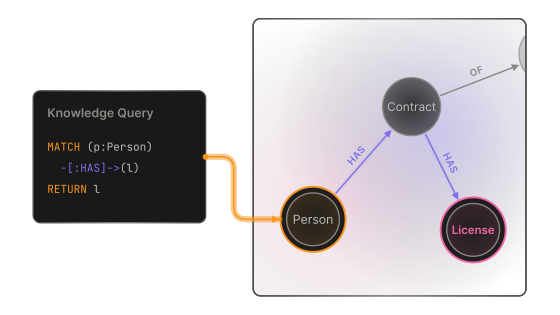
Query the IndyKite Knowledge Graph (IKG) to retrieve all vehicle license numbers that a specific person is authorized to view based on their contractual relationships.
ContX IQPythonContX IQ: Which payment methods do contracted vehicle users have?
Query the IndyKite Knowledge Graph to list all payment methods belonging to people who have active contracts for vehicles. This demonstrates linking an Application to graph data and querying through authorized relationships.
ContX IQJsonContX IQ: How do I grant unrestricted READ access to a node category?
Create a policy that allows any authenticated request to READ all nodes of a specific type (e.g., all LicenseNumber nodes) without requiring relationship-based authorization.
ContX IQJsonContX IQ: How do I create nodes and relationships with an authorized write query?
Demonstrates how to create new Contract nodes and relationships (COVERS, ACCEPTED) through an authorized ContX IQ write query. The Application can only create contracts for vehicles owned by companies it has agreements with.
ContX IQJsonContX IQ: How do I upsert relationships between existing nodes?
Create or update (upsert) relationships between existing nodes in the graph. This example demonstrates using the allowed_upserts.relationships policy directive to authorize ACCEPTED relationships between Person and Contract nodes.
ContX IQJsonContX IQ: How do I delete nodes and their relationships with an authorized query?
Demonstrates authorized node deletion in the IndyKite Knowledge Graph. When a node is deleted, all its relationships are automatically removed. This example shows deleting Contract nodes for a specific Person.
ContX IQJsonContX IQ: Loyalty Program - Which payment method belongs to this license plate?
Real-world loyalty program scenario: Given a vehicle's license plate number, retrieve the credit card associated with an authorized user. Demonstrates multi-condition authorization with consent validation and loyalty plan membership checks.
ContX IQBashContX IQ: How do I list the Knowledge Queries of a project?
List the Knowledge Queries of a project with GET /configs/v1/knowledge-queries: a metadata-only list by default, with each query's id, name, display name, description and status, full_fetch=true to include the query text and policy_id, and search= to filter by name, display name or description.
ContX IQJsonContX IQ: How do I connect system nodes (_Application) to business data?
Learn how to link auto-generated system nodes (_Application, _AppAgent) to your business data in the knowledge graph. This is essential for using the Application as an authorized subject in ContX IQ queries.
ContX IQJsonContX IQ: Complete CRUD Workflow with _Application as Subject
Comprehensive example showing how an Application can read resources, create relationships to those resources, and then create new nodes. Demonstrates progressive authorization as the graph structure changes.
ContX IQJsonContX IQ: How do I create a user node from an access token and authorize through organization membership?
Create a User node from the caller's access token, link it to an ingested UserProfile, then read and upsert Event nodes according to the UserProfile's BELONGS_TO relationship with its Organization. The policy filter reads the token's sub claim and the role property stored on the relationship.
ContX IQJsonContX IQ: User Consent Management - How does a user grant and revoke payment access?
Demonstrates user-controlled consent workflows where a Person can authorize a Company to access their payment method, and later revoke that access. Uses user tokens as subjects for self-service data governance.
ContX IQJsonContX IQ: How do I require step-up authentication based on the auth_time claim?
Enforce re-authentication for sensitive operations by checking the token's auth_time claim. If the user authenticated more than one hour ago, return an advice requesting fresh authentication.
ContX IQJsonContX IQ: How do I require step-up authentication based on the token issue time (iat claim)?
Enforce token freshness by checking the iat (issued at) claim. If the token was issued more than one hour ago, return an advice requesting a new token. Different from auth_time - this checks token age, not authentication age.
ContX IQJsonContX IQ: How do I query external data sources via Data Resolver?
Demonstrates fetching data from external systems (APIs, databases) during ContX IQ query execution. The External Data Resolver retrieves information not stored in the IKG, combining graph data with real-time external lookups.
ContX IQJsonContX IQ: Manage Node Property Metadata
Add, update, and query metadata on node properties. Metadata provides additional context like timestamps, sources, confidence scores, or audit information for individual property values.
ContX IQJsonContX IQ: Delete Node Properties and Relationship Properties
Demonstrates granular delete operations: delete entire nodes, specific properties from nodes, and specific properties from relationships. Useful for data cleanup, GDPR right-to-erasure, and selective data removal.
ContX IQJsonContX IQ: Application as Service - How do I create a Person linked to multiple nodes?
Demonstrates service-to-service data creation where an Application (not a user) creates new Person nodes and links them to existing Country and Company nodes. Common pattern for system integrations and automated data pipelines.
ContX IQJsonContX IQ: How do I fetch all properties of a node with a wildcard?
Use wildcard syntax to retrieve all properties of a node or relationship without explicitly listing each one. Simplifies queries when you need complete data snapshots or don't know all property names in advance.
ContX IQJsonContX IQ: Which nodes are directly connected to a user?
Query all nodes that have a direct relationship with a specified User node, regardless of relationship type or direction. Useful for user profile views, data export, or understanding a user's complete data footprint.
ContX IQJsonContX IQ: How do I filter data with the IN array operator and a user subject?
Query Contract nodes using the IN operator to filter by array values in policy conditions. Demonstrates how to check if a value exists within an array property during authorization.
ContX IQJsonContX IQ: How do I aggregate data with WHERE, WITH and COUNT?
Demonstrates advanced Cypher query patterns including WHERE filtering, WITH for intermediate results, and COUNT for aggregation. Returns Person data with contract counts.
ContX IQJsonContX IQ: Is this resource available? OPTIONAL MATCH and CASE expressions
Demonstrates OPTIONAL MATCH for pattern matching that doesn't fail when no match exists, combined with CASE expressions for conditional logic. Example: Check if a subdomain is available for registration.
ContX IQJsonContX IQ: Paginated Query Execution with page_token and page_size
Walk a large CIQ result set across multiple /contx-iq/v1/execute calls using the page_token and page_size request fields. Demonstrates client-side pagination of an authorized read query.
ContX IQPythonContX IQ: Resolve the Caller's IKG Subject with GET /contx-iq/v1/whoami
Ask IndyKite which IKG node an end-user token resolves to. GET /contx-iq/v1/whoami returns the subject type and external ID that Token Introspect derived from the bearer token - and nothing else - so a client can build subject-bound AuthZEN and CIQ requests without decoding the token itself.
ContX IQJsonContX IQ: Keep a Slow Condition on the Node-Type Indexes with condition.skip_resource_label
A read policy whose condition is matched on the node type labels only: condition.skip_resource_label leaves out the :Resource system label the platform otherwise adds to every named node, so the query planner works from :Person, :Bus and :LicenseNumber alone. Same Knowledge Query, same results, different plan. The example captures a three-node graph, saves the policy and the query, executes as the owner, and shows the Cypher the platform derives with and without the flag.
ContX IQJsonContX IQ v2: Write Values Read from the Graph with @ References
A CIQ v2 (2.0-ciq) write: one Knowledge Query copies the caller's email and a licence number value onto the bus the caller owns, with @ references in its upsert values, so the client sends no values at all. The example captures a three-node graph, saves the 2.0-ciq policy and the query, executes as the owner, and reads the written values back in the same call.
ContX IQJsonContX IQ v2: Read a Whole Relationship with Its Endpoints
A CIQ v2 (2.0-ciq) read that returns a whole relationship: it comes back as its two endpoints, each with its external_id and type, and its properties. The example captures a three-node graph with a property on OWNS, saves the 2.0-ciq policy and the query, and executes as the owner.
Token Introspect 2 resources
 Token IntrospectJson
Token Introspect: How do I validate tokens with an OAuth 2.0 introspection endpoint or RFC 8414 discovery?
Two Token Introspect configurations for authorization servers that are not plain OpenID Connect providers: online_oauth2_validation posts an opaque token to an RFC 7662 introspection endpoint with client credentials, and offline_validation.discovery = rfc8414 fetches a JWT issuer's keys from its OAuth 2.0 authorization-server metadata. Shows the create, the read that never returns the client secret, the update that keeps it, and the exact 422 messages.
Token IntrospectJsonToken Introspect: How do I bind Bearer token claims to a Person subject for CIQ queries?
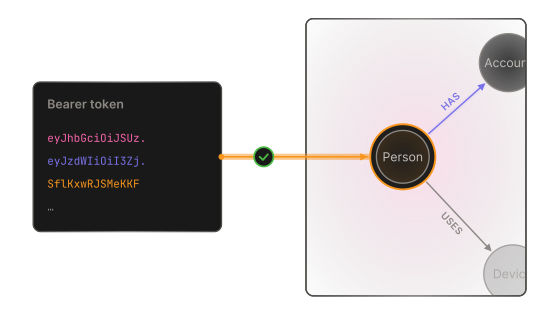
End-to-end example showing how the Token Introspect configuration, the data ingested via the Capture pipeline, and a CIQ policy lock together. The bearer token's sub claim selects the Person subject; the token's email claim cross-references the captured Person.property.email; the CIQ query returns only that user's profile.
KBAC 10 resources
 KBACPython
KBAC: Can this person act on that resource? Relationship-based authorization with the AuthZEN API
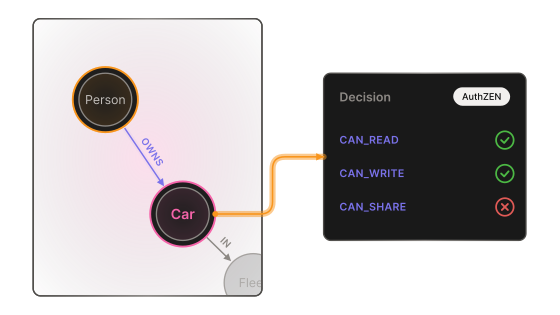
Create a Knowledge-Based Access Control (KBAC) policy and execute authZEN-compliant authorization queries. This example demonstrates evaluation (can X do Y to Z?) and search operations (who can? what can? which resources?).
KBACPythonKBAC: Batch Authorization with Multiple Evaluations (Boxcarring)
Evaluate multiple authorization decisions in a single API call using the authZEN Access Evaluations endpoint. This pattern, known as 'boxcarring', reduces network overhead when checking many permissions at once.
KBACPythonKBAC: How do I return step-up authentication advice in an authorization response?
Demonstrates authZEN 'advice' - when authorization is denied due to insufficient authentication level, the response includes guidance on what authentication step-up is needed to gain access.
KBACPythonKBAC: How do I parameterize an authorization decision with input params (max_price)?
Drive authZEN evaluation and resource-search decisions using runtime input_params. The policy condition compares a graph property against $max_price provided at execution time, so the same policy answers different shopping-budget questions per call.
KBACJsonKBAC: What can one subject do across many resources? A permission grid with AuthZEN evaluations (boxcar)
Use the authZEN /access/v1/evaluations endpoint to check, in a single call, whether one subject is allowed across a grid of (resource, action) cells. The response returns one decision per cell, in order; the client keeps the cells whose decision is true.
KBACJsonKBAC: Token-Scope-Gated Read/Write Permissions
Gate KBAC actions on the bearer token's scope claim. CAN_READ requires scope 'cars.read', CAN_WRITE requires scope 'cars.write'. The graph relationship grants the base capability; the token scope decides which verbs are exercisable on this request.
KBACJsonKBAC 3.0: Raw-Cypher Policies with CALL { } Subqueries and USE Routing
Author 3.0-kbac policies using the Cypher keywords that only this version accepts: USE graph.byName() database routing and CALL { } subqueries with inner RETURNs. The condition runs as raw Cypher - the platform only pins the subject/resource and appends the projection; the USE routing shown here targets a composite IKG.
KBACJsonKBAC 3.0: Data Residency - How do I route AuthZEN decisions by location?
Route authorization decisions to a specific location of a composite IKG at request time. A 3.0-kbac policy declares USE graph.byName($region); each AuthZEN call supplies a logical location (an alias_mapping key) in context.input_params, and IndyKite translates it to the physical constituent database.
KBACPythonKBAC: List the Active Authorization Policies of a Project with GET /access/v1/policies
Read the active KBAC policies of the calling application agent's project at runtime. GET /access/v1/policies returns each policy exactly as stored, inlined as a JSON object, together with its tags; the optional subject_type query parameter narrows the list to the policies written for one subject type. Requires the ReadAuthZConfigs API permission on the agent.
KBACBashKBAC: Decide on a Delegation Chain with the X-IK-Token Header and $ik_token Claims
Let a policy decide not only who the user is but through which agent the user is acting: a delegation token in X-IK-Token, minted by the IndyKite Token Service with an RFC 8693 exchange, is bound as $ik_token in the policy, next to the user token's claims as $token. The example grants CAN_SHARE on a managed document only when the call comes through the knightrider agent, shows the decision flip to false without the delegation token, proves that input_params cannot impersonate either token, and lists the 401 and 422 the platform returns for a mismatched subject and a mistyped prefix.
Outbound Events 4 resources
 Outbound EventsJson
Outbound Events: Configure Kafka Event Streaming
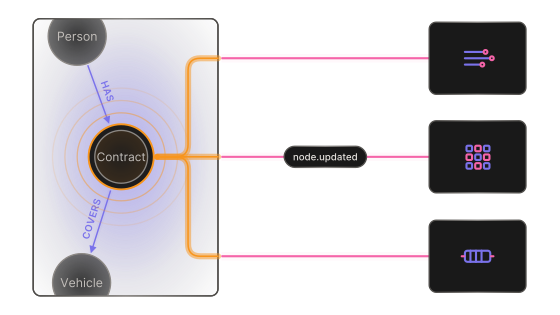
Set up real-time event streaming from IndyKite to Kafka (Confluent). Receive notifications when graph data changes, configurations are modified, or specific actions occur.
Outbound EventsJsonOutbound Events: How do I stream graph data changes to Kafka?
Configure event streaming for Knowledge Graph changes. Receive real-time notifications when specific node types are created, updated, or deleted. Filter by node labels and properties.
Outbound EventsJsonOutbound Events: How do I stream events to Azure Event Grid?
Configure event streaming to Azure Event Grid for serverless event processing. Trigger Azure Functions, Logic Apps, or other Azure services when graph data changes.
Outbound EventsJsonOutbound Events: How do I stream events to Azure Service Bus?
Configure event streaming to Azure Service Bus for enterprise messaging patterns. Enable reliable message delivery with queues and topics for decoupled, scalable architectures.
TrustScore 2 resources
 TrustScoreJson
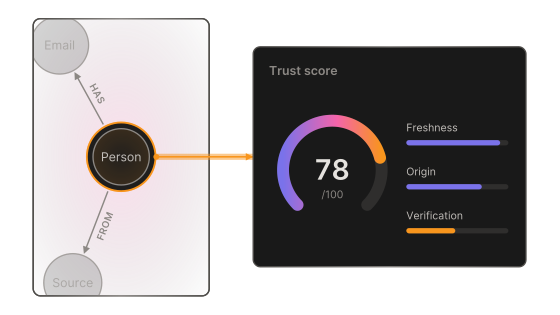
Trust Score: How do I filter CIQ queries by a subject's trust score threshold?
Configure a Trust Score Profile for Person, ingest two Persons with different metadata quality via the Capture API, let the profile compute a _TrustScore for each, then run a CIQ query that returns the caller's own profile only when their _final_score is at or above the requested threshold.
TrustScoreJsonTrust Score: How do I read per-dimension scores from a LicenseNumber for document vetting?
Configure a Trust Score Profile that weights dimensions unevenly for LicenseNumber nodes (validity heaviest, completeness lightest), capture two license numbers with different metadata quality, and run a CIQ query that returns the full per-dimension breakdown - not just the final score - so a vetting UI can show exactly why a document is or isn't trustworthy.
Environment 3 resources
 EnvironmentJson
How do I set up an IndyKite environment: project, application and credentials?
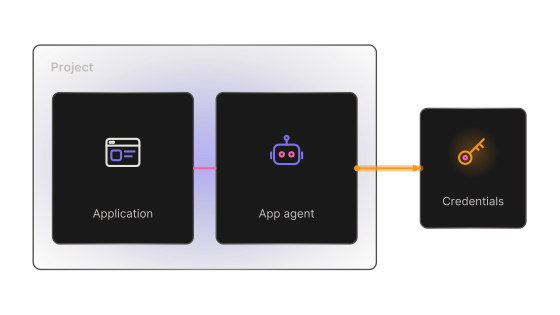
Create the foundational IndyKite environment components required before using any IndyKite product. This includes creating a project, application, application agent, credentials, and token introspect configuration.
EnvironmentJsonOrganization and Service Accounts: Identify the Organization, Create a Service Account, Issue and Revoke Its Credentials
Manage the organization layer of the Config API: read the current organization, create a Service Account with the all_editor or all_viewer role, issue a credential and keep its file, list and inspect credentials, update the account with an ETag, and revoke a credential.
EnvironmentJsonData Residency: How do I run a composite-database project with location-routed ingestion?
Set up a project backed by a customer-hosted composite database, create the application hierarchy and credentials, then ingest nodes routed to specific locations, with a proxy in the global database for the nodes that ask for one, and relationships routed by the locations of their nodes.
Capture 1 resource
Data Schema 1 resource
External Data Resolver 2 resources
 External Data ResolverJson
External Data Resolver: How do I set a data reference in a CIQ upsert and return the resolved value?
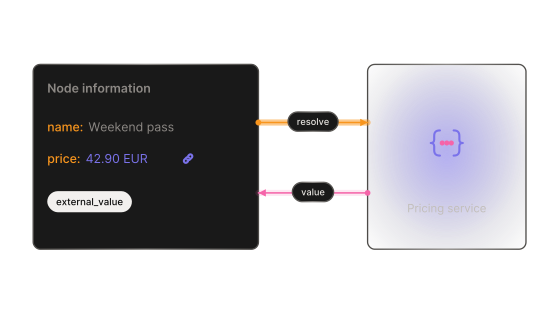
Use a CIQ upsert with external_value to turn a node property into a data reference pointing at an External Data Resolver chosen per call. The IKG never stores the price: the upsert stores the reference, and the same /contx-iq/v1/execute call resolves it against the pricing service and returns the current value.
External Data ResolverJsonExternal Data Resolver: How do I compose two resolvers in a single Knowledge Query?
Attach two External Data Resolver configurations to two different properties on the same node - at read time, CIQ invokes both resolvers and returns their results alongside ordinary IKG data, all in one /contx-iq/v1/execute call.
MCP 2 resources
 MCPJson
MCP Server: How do I initialize a session and execute tools over HTTP?
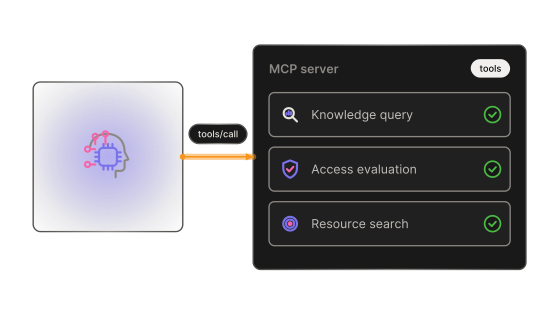
Demonstrates how to interact with the IndyKite MCP (Model Context Protocol) server using HTTP requests, with the session-based MCP protocol (revision 2025-11-25). Covers session initialization, listing resources and tools, and executing authorization queries through MCP tools. For the stateless protocol (revision 2026-07-28), see the companion resource.
MCPJsonMCP Server: Stateless Tool Calls with Protocol 2026-07-28
Demonstrates the stateless MCP protocol (revision 2026-07-28) against the IndyKite MCP server: no initialize handshake and no Mcp-Session-Id - every request is self-contained, carrying its protocol metadata in params._meta plus the standard MCP headers. Same environment and tools as the session-based MCP resource.