Download the whole tutorial, all five chapters, as a PDF: tutorial-audit-acceptance.pdf.
A tamper-proof audit log is only worth its name once someone outside the platform has verified it. This tutorial is that first verification, written as an acceptance test: short enough to run in an afternoon, exact enough to be the gate before the one-way decisions of a dedicated deployment, such as locking the bucket's retention. It works just as well against the shared IndyKite platform, where the infrastructure is not yours but the proof still is.
It uses curl, jq and one Go file you download. Nothing here needs the Hub beyond the credentials you create there once.
What you will have at the end
- Audit events of your own in the project's chain: Capture upserts and configuration reads.
- Two saved API responses: a page of signed batches and the JWK Set that signed them.
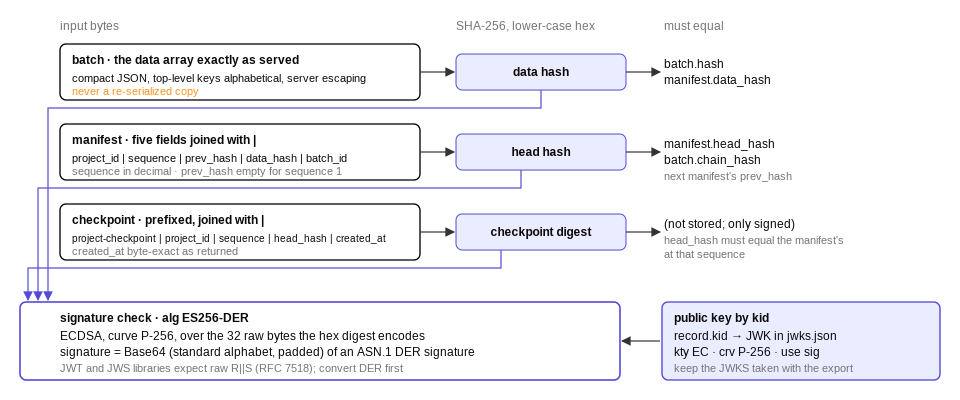
- A verifier you ran yourself, which recomputed every batch hash, checked every signature against the published keys and followed every chain link on the page.
- The ability to read its output: what each failure line means, which ones point at the data and which at the keys.
- Proof that the verifier bites: the same page altered by one character, and the lines that catch it.
Prerequisites
- An IndyKite project and its GID, a Service Account credential for the Config API, and an Application Agent credential holding the
AuditandCaptureAPI permissions. Chapter 1 lists where each comes from. - A destination you own for an Event Sink (a Kafka topic, a Pub/Sub topic, an Event Grid topic or a Service Bus queue): the chain holds only the events a sink of the project delivered, so chapter 2 creates one, together with the Audit Signing configuration that switches the chain on.
curl,jq, and Go 1.25 or later for chapter 4.- For a dedicated deployment: the public API host of that deployment, and someone on the platform side who can tell you the integrity verifier's last exit code (chapter 5).
Who this tutorial is for
Platform and security engineers accepting a dedicated deployment of the audit log, as described in the infrastructure guide; compliance teams who want a repeatable spot check; and anyone who prefers a single Go file to a Python environment. For the full export, with manifests and checkpoints, and the operating habits around it, continue with the audit trail tutorial.
The flow at a glance